
How to Sound Less Like AI
Hey Rhetors,
I’m tired of unlocking things.
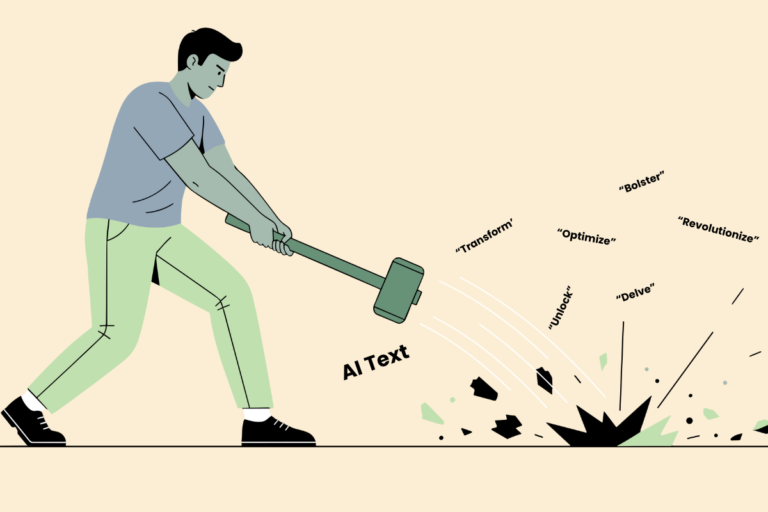
I’m also tired of delving into a topic, streamlining a system, and reading about something “someone” called game-changing. I’m sure you’re tired of doing this too. How many times have you scrolled past a post with one of the buzzwords above? You might not even notice you’re doing it anymore. The effects of AI generated content have touched nearly every screen you or I have ever interacted with in the last five years, and I fear the day when they start selling AI alarm clocks that tell me it’s time to “bolster” my day.
Surely, people don’t sound like this, right? How can something created by us sound so unlike us?
I’m afraid we already do sound like AI, and unfortunately, AI is influencing us, not the other way around. Let’s “delve” into why that is, and how you can stay fresh with it in an AI slop world.
Who Said It First, The AI or the Human?
Today, I’m lightly stealing a topic already talked about largely by Adam Aleksic, also known as The Etymology Nerd. He’s created success for himself on the algorithm by talking about the algorithm, or what it does to our language. In his most recent TED Talk, Aleksic broke down how the word “delve” became such a popular word in our everyday vernacular. Which it is, by the way. Compared to words with a similar meaning and used about the same amount before AI, the top 20 ChatGPT used words are being used by people in podcasts and youtube 25% to 50% more year over year.
Adam’s picture for why this is happening paints a grim reality. And it goes a little like this. Because not everyone is always using ChatGPT, those who use it more often are adding more biased input. The AI’s goal is not to know everything about you, but what you do put into it allows it to give you a better response. However, these chatbots also have an additional layer to keep you using them. After all, that’s how chatbot companies make money, by getting better at outputting for paid subscribers or larger companies.
So instead of just our own biases affecting outputs, its own biases are too, resulting in the usage of specific and repetitive words that essentially get the job done. Have I “refined” your understanding or “integrated” the concept in your brain yet?
Aleksic does a great job of showing the issue. However, I didn’t really get a solution after learning about it. So instead, I sought some out myself.
3 Ways to Sound Less Like AI
1. Be Less Concise, but Stay Simple
All of my English teachers probably just felt a rush unease. I was always taught to get to the point as fast as possible. But when everyone is trying to be as efficient as possible, what’s one or two roundabouts or red herrings in a story to add suspense? The next time you find yourself using an AI like word, think about how you got to the point where you had to use that word, and next time, try to add more context, or approach the topic from another angle. With practice, you’ll find ways to stay interesting.
2. Keep it Concrete, Kook
Most of the buzzwords used by AI are somewhat abstract. Case in point, I don’t think anyone is trying to overthrow or restructure my dinner when they say they want to “revolutionize my nutrition” with a new power bowl meal (yeah, that was a real post I saw). Instead of following that same line of “keep it simple, stupid (KISS),” try “keep it concrete, kook (KICK).” Stay grounded in reality with your words, and people will still get the point.
3. Lean on Emotion
I said this earlier in my post, but if AI were to truly be accurate, you would have to be using it all the time, and it would need to know everything about you. Unless you’re jacked into the system like Case in Neuromancer, AI can never know what you’re feeling (if you don’t get the Case reference, read this amazing novel by William Gibson). So, interject your conversation with words that help you express how you’re feeling. You’ll stay fresh and give the opportunity to someone else to show empathy.
This Week: Count Your Chatbot Words
I love journaling. Last week, I counted myself using an AI like buzzword 6 times in my writing and speaking, adding a little hash mark to an entry I started a the beginning of the week. How many do you think you use? I’m sure you’ll surprise yourself, and what’s better, you might learn to catch yourself next time and use the lessons above.
Talk (like a person) soon,
Tim
Curation Corner
If this is your first TWR post, here’s the skinny. Every week, I put together the following, so you can explore communication related and adjacent works by people much more creative and skilled than me! Take a look at this week’s below:
Quote of the Week: “If there is one general law of communication it is that we never communicate as effectively as we think we do.” – Charles Handy: azquotes.com/author/22005-Charles_Handy#:~:text=staffed%20by%20masochists.-,Charles%20Handy,49%20Copy
Video of the Week: “Kids being kids” by allonblack8: https://www.instagram.com/reel/DPK3-ltgsVp/?igsh=ZGk4b2tka2x6YWk4
Podcast of the Week: “10 breakthrough technologies to expect in 2026” by Short Wave: https://open.spotify.com/episode/29EOHrzeSp9uDKRqfN0C9N?si=ab2a6ce3e62040b3
Book of the Week: Blink by Malcolm Gladwell: https://www.goodreads.com/book/show/40102.Blink