
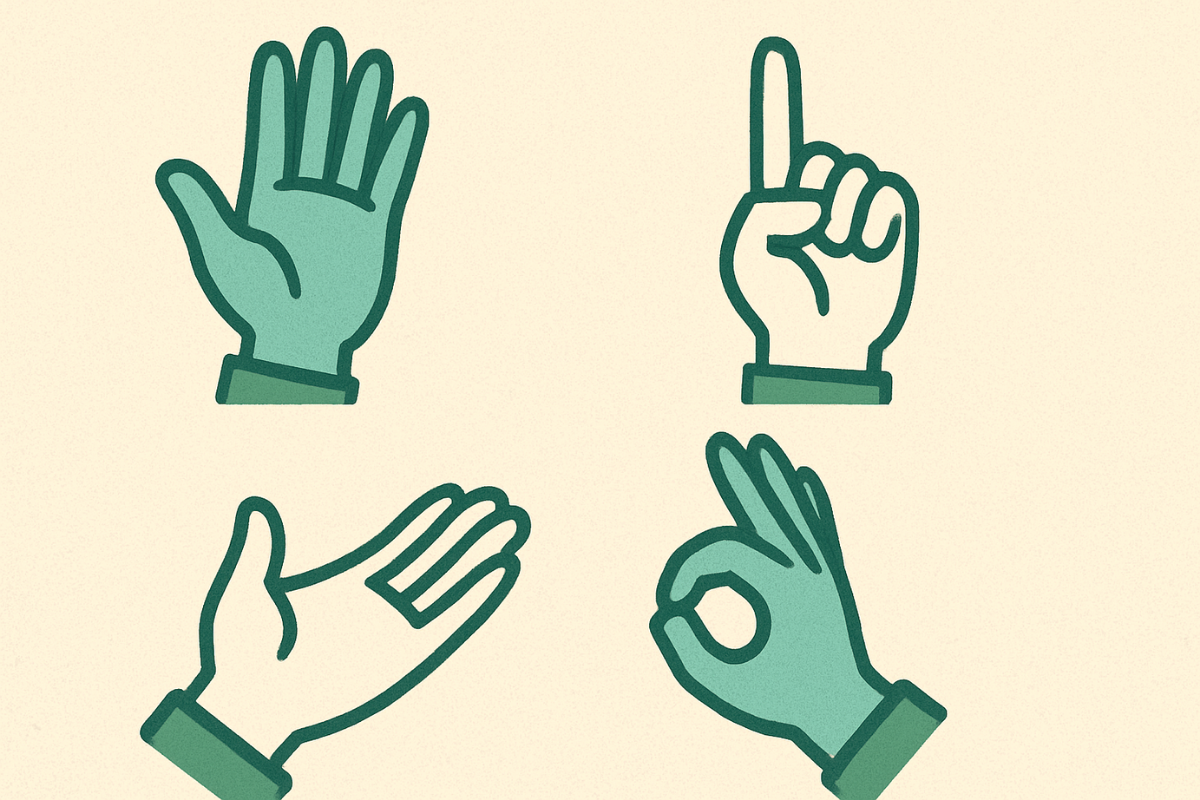
Giving Your Message a Helping Hand
Hey Rhetors,
When’s the last time you whipped out one of these bad boys in a conversation? 🤌
If you’re not Italian, chances are it wasn’t recent, and if it was, I bet it wasn’t intentional! Italian culture has roughly 250 defined hand gestures. The reasons these came to be are actually a historical mystery, but many theorize that it had to do with the multiple dialects of Italian in ancient times, and the need to communicate in trade.
Look, none of us are peddling wine throughout the Mediterranean (if you are, email me!), so you don’t need to learn these specific gestures. But using your hands in communication is an art that we pay way too little attention to, because those mitts are pretty powerful tools! Unfortunately, the skill is tough to study on yourself. Often, we gesture naturally when we’re not thinking about it, but the second we pay attention to our hands, they suddenly seem to have no clue what to do.
Why is that? Why do we instinctively gesture, but then shut down when the spotlight’s on? And how do you get better at using hand gestures naturally if, when you want to practice, you either get distracted or they go mute?
Let’s dive into these hand mechanics of communication, and subtle techniques you can use without distracting yourself and everyone else.
Why We Use Hand Gestures (Even If We Don’t Notice It)
Let’s first hammer home a point. Your hands were made for more than making/holding tools and touching grass. A 2023 Georgia State study found that hand gestures may be part of a universal nonverbal communication system used across languages, cultures, and even species. The researchers observed consistent meanings in certain hand movements, supporting the idea that gesturing is deeply wired into human communication, possibly even evolutionary.
So if you’re one to stuff your hands in your pockets, consider changing that habit as soon as possible. At their base level, gestures can:
- Emphasize important points
- Replace words altogether when language falls short
- Help listeners understand abstract or complex ideas
- Reinforce emotion and tone
In short: your hands are saying something even when your mouth isn’t. And when they’re working with your voice, they supercharge your message.
“Handy” Tips
So how do you strike the balance between a natural flow and distracting movement? The key is intentionality. Here are a few guiding principles I’ve pulled from communication coaching and presentation experts:
1. Use Open Gestures
Palms up, hands relaxed. Open gestures create trust and signal transparency. Think “inviting the audience in,” rather than “defending yourself from an attacker.”
2. Be Expansive, Then Return to Center
Gestures should support your message, not distract from it. You want to be expressive, but with rhythm: big ideas can have big gestures, but always bring your hands back toward your body’s center to reset.
3. Match Movement to Meaning
Want to emphasize contrast? Use a chopping motion. Building to a point? Stack your hands as you talk. Describing size or quantity? Use spatial gestures to map it out. Let your hands sketch what your words are saying. This comes a little easier for visual learners, but we can all do it!
4. Stillness Has Power, Too
You don’t need to move constantly. In fact, a purposeful pause in your gesturing can be just as powerful as a sweeping motion. Just like harmful filler words, don’t overuse gestures to fill the space.
If the person is receptive, they’ll give you more than just a “Yes,” “No,” or grunt. From there, simply introduce yourself and let the conversation roll! Over anything, turn the conversation to them, and be genuinely curious. If you take anything away from my blog, it’s that. And, again, #notsponsored, Trader Joe’s soup dumplings are delicious.
How to Practice Gesturing
Note: what I’m about to say will probably make you cringe. But, it’s simply the most effective way to get better at the art: record yourself talking about a topic!
Yes, it’s uncomfortable to watch yourself. I had to do it countless times when I was in a client services role. But reviewing yourself, even for 30 seconds, can help you spot stiff movements, overuse, or gestures that don’t match your tone.
If you’re still on the fence about doing it, I’ll let you in on a secret: motivational speakers, CEOs, TED Talkers, salespeople, essentially anyone in a communications related role since the age of the iphone has watched themselves back for practice. If you want to be on par, it’s something you should try!
Gesture Up This Week
This week, I dare you to notice your hands.
In one conversation, be conscious of how your hands move. Are they helping you talk? Hurting your flow? Hiding? Then try adjusting slightly. Open up. Gesture with intention. See if it makes you feel more confident or helps your message land.
If you’re feeling bold, record yourself explaining something simple (how to make your favorite sandwich, or why your friend is wrong about their ranking of Pixar movies) and watch your hands. What are they doing? What should they be doing?
Remember: effective communication involves your whole self. Even the parts you might stuff in your pockets.
Curation Corner
If this is your first TWR post, here’s the skinny. Every week, I put together the following, so you can explore communication related and adjacent works by people much more creative and skilled than me! Take a look at this week’s below:
Quote of the Week: “Learning is not attained by chance; It must be sought for with ardor and intelligence” – Abigail Adams:https://founders.archives.gov/documents/Adams/04-03-02-0240
Video of the Week: “Oreo CEO: Stop Making New Oreos” by Dropout: https://youtu.be/CMkYw4dp_NI?si=_9-Rgn2UWeN4UxYa
Podcast of the Week: “How to Disagree Better” by LifeKit: https://open.spotify.com/episode/2yZzP4qn6a2NuRC8cAxCuH?si=6ac6a6f4796c40fc
Book of the Week: The Old Man and the Sea by Ernest Hemingway. You’ll find that the Old Man regards his hands often too! https://www.goodreads.com/book/show/2165.The_Old_Man_and_the_Sea